

Lower Manhattan is where New York began, but it is also one of the parts of the city that has changed most dramatically. Colonial streets, Wall Street, the 9/11 Memorial, glass towers, harbor views, churches, historic taverns and waterfront parks all sit within a relatively compact area. For first-time visitors, that density makes Downtown tempting to rush. The better approach is to slow down and let the neighborhood tell its story in layers.
This Lower Manhattan and Financial District guide is designed for travelers who want more than a photograph of the Charging Bull. It explains the best sights, how to walk the area efficiently, where to pause, how to combine history with modern New York and which places deserve advance planning in 2026.
Where does Lower Manhattan begin?
There is no single official tourist boundary, but for practical trip planning Lower Manhattan usually means the area south of roughly Chambers Street. Within it are the Financial District, World Trade Center, Battery Park City, the Civic Center, the Seaport and the southern tip of Manhattan. Subway coverage is excellent: Fulton Street, World Trade Center, Wall Street, Bowling Green and South Ferry are the most useful stations for visitors.
Downtown is also one of the easiest parts of Manhattan to explore on foot because many major sights are only ten or fifteen minutes apart. The challenge is not distance; it is deciding what deserves time.
1. Start at the World Trade Center
The rebuilt World Trade Center is one of the clearest places to begin because it connects recent history, architecture, transport and skyline views. The Oculus is both a transit hub and a dramatic piece of architecture. Walk through it rather than simply photographing it from outside, because the building makes more sense when you see how it connects PATH trains, subway stations, shops and the memorial area.
From here, the 9/11 Memorial is only a few steps away. The two reflecting pools occupy the footprints of the former Twin Towers and are surrounded by the names of those killed in the attacks of September 11, 2001 and the 1993 World Trade Center bombing. In 2026 the outdoor Memorial is open daily, while the Museum operates on a separate schedule. Check the official 9/11 Memorial & Museum website before visiting because Tuesday openings and holiday hours can vary.
2. Decide whether the 9/11 Museum fits your day
The 9/11 Museum is not a quick attraction. It is emotionally heavy, detailed and best visited when you can give it real attention. If you enter, avoid scheduling another timed attraction immediately afterward. Many visitors benefit from a quiet walk along the Hudson or through Battery Park City once they leave.
If you are traveling with young children, think carefully about whether the museum is appropriate for them. The outdoor Memorial can be visited independently and allows families to discuss the history at their own level.
3. Walk to Trinity Church and Wall Street
Continue east toward Broadway and you reach Trinity Church, one of the most visually striking contrasts in Downtown: a Gothic churchyard framed by modern towers. The present church building dates to the 19th century, but the parish is much older. Alexander Hamilton is buried in the churchyard, along with other notable figures from early American history.
From Trinity Church, Wall Street is only a short walk. The street itself is narrower and less cinematic than many first-time visitors expect. That is part of the appeal. Stand near the intersection of Wall and Broad Streets and you are surrounded by institutions that shaped American finance and government.
4. Federal Hall: a small stop with a huge story
Federal Hall National Memorial, at 26 Wall Street with the visitor entrance at 15 Pine Street, marks the site where George Washington took the oath of office as the first U.S. president in 1789. The current Greek Revival building came later, but the site remains one of the most important historic places in Lower Manhattan.
Admission is free. In 2026 the National Park Service lists regular opening Wednesday through Sunday, 10 a.m. to 4 p.m., but always confirm before going on a holiday. Even a short visit adds valuable context to a Wall Street walk. Use the official National Park Service page for current hours.
5. New York Stock Exchange and Fearless Girl
The New York Stock Exchange facade on Broad Street is one of the iconic images of the Financial District. General tourist access to the trading floor is not part of a normal visit, so treat the exterior as an architectural and historical stop rather than planning to go inside.
The Fearless Girl statue stands nearby and draws steady crowds. If you want a clean photograph, come early on a weekday. By midday the area can feel busy with office workers, tour groups and security barriers.
6. The Charging Bull: go early or keep expectations realistic
The Charging Bull near Bowling Green is one of New York’s most photographed sculptures. It is also one of the least relaxing. Lines for photographs can be long and the small traffic island gets congested quickly. If the sculpture matters to you, visit early in the morning. Otherwise, look at it, enjoy the symbolism and keep moving toward The Battery.
Do not build your entire Financial District experience around this one stop. Lower Manhattan’s history is far richer than a single bronze bull.
7. The Battery and harbor views
The Battery is the green space at Manhattan’s southern tip. It gives you open views toward the Statue of Liberty, Ellis Island and New York Harbor and makes an excellent break after the dense streets of Wall Street. The park has been undergoing major resilience and waterfront improvements, so individual paths or sections can change. Follow signs on site rather than relying on an old map.
If you are visiting the Statue of Liberty, official ferries depart from this area. If not, the park is still worth visiting for the harbor atmosphere alone.
8. Take the Staten Island Ferry for a free harbor ride
One of New York’s best-value experiences costs nothing. The Staten Island Ferry runs between Whitehall Terminal in Lower Manhattan and St. George on Staten Island. NYC DOT confirms that the service is free and operates every day, year-round. The crossing takes roughly 25 minutes and offers good views of the harbor and Statue of Liberty.
Use the ferry as transportation, not as a private sightseeing cruise. Commuters depend on it. Avoid blocking doors or stairways for photographs, and check the official schedule before planning around a specific departure.
9. Stone Street and the old street pattern
Stone Street is often photographed for its low-rise historic atmosphere and outdoor tables. It is a pleasant place for a meal or drink, especially in good weather, but its real value is that it reminds you how different Downtown’s street pattern is from Midtown’s grid.
Wander a little. Streets such as Pearl, Beaver, William and South do not line up in the neat way many visitors expect. This irregularity is part of the old city and gives Lower Manhattan a texture that disappears farther north.
10. South Street Seaport and Pier 17
Walk northeast and Lower Manhattan changes again. The South Street Seaport combines cobbled streets, preserved buildings, maritime history, restaurants and modern waterfront spaces around Pier 17. It can feel polished, but the views of the Brooklyn Bridge and East River are excellent.
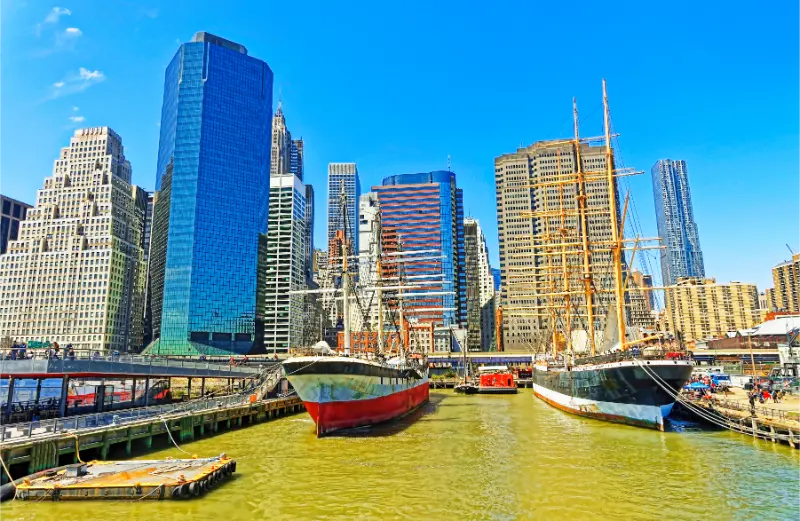
This is a good late-afternoon stop if you plan to continue across the Brooklyn Bridge or take an NYC Ferry. For a broader Brooklyn plan, see our Brooklyn travel guide.
11. One World Observatory
If you want a skyline viewpoint Downtown, One World Observatory sits at the top of One World Trade Center. The experience is largely indoors, which makes it useful in winter, rain or strong wind. Views extend across the harbor, Downtown, Brooklyn and New Jersey.
Because New York now has several major observation decks, do not assume you need to visit all of them. Our New York observation decks comparison helps you choose the one that best fits your itinerary.
12. African Burial Ground National Monument
North of the core Financial District, the African Burial Ground National Monument tells an essential part of New York’s story that many visitors miss. The site preserves and interprets a burial ground used by free and enslaved Africans during the 17th and 18th centuries.
The National Park Service operates a visitor center and outdoor memorial with scheduled opening days. It is a strong stop if you want to understand how much of New York’s history is hidden beneath modern streets.
A practical half-day Lower Manhattan route
For a first visit of four to five hours, begin at the World Trade Center and 9/11 Memorial, walk to Trinity Church and Wall Street, visit Federal Hall if open, continue to the Charging Bull and The Battery, then finish with Stone Street or the Seaport. This route is compact and gives you history, architecture and harbor views without exhausting the day.
If you want to include the 9/11 Museum, add at least two hours and reduce the number of smaller stops. Do not try to do the museum, Statue of Liberty, Wall Street, Brooklyn Bridge and Seaport all before lunch.
A full-day Downtown itinerary
Start early at the 9/11 Memorial, enter the Museum if it is a priority, have lunch around the Financial District, walk Wall Street and The Battery, then choose one major afternoon experience: Statue of Liberty and Ellis Island, One World Observatory, Staten Island Ferry or South Street Seaport. End the day with a Brooklyn Bridge walk if you still have energy.
Our 5-day New York itinerary shows how to place Downtown within a first trip.
Where to eat in the Financial District
The area is much better for food than it was years ago. Office-worker lunch spots, historic taverns, food halls and waterfront restaurants give you plenty of options. If you want atmosphere, Stone Street works well. For variety, the Oculus/World Trade Center area and Brookfield Place have many choices. For something less polished, walk toward Chinatown rather than settling for the first chain you see.
See our where to eat in New York guide for more specific ideas.
Best time to visit Lower Manhattan
Weekday mornings give you the clearest sense of the Financial District as a working neighborhood. Weekend mornings are calmer and better for photography. Summer afternoons can be hot on exposed streets and waterfronts, while winter wind around the harbor can be intense.
If you want the Brooklyn Bridge at the end of the day, check sunset time and leave enough daylight to reach the Brooklyn side comfortably.
Common mistakes to avoid
- Trying to see the 9/11 Museum in thirty minutes.
- Assuming Wall Street is a single attraction rather than a historic district.
- Waiting a long time for a Charging Bull photo while skipping Federal Hall.
- Booking the Statue of Liberty and One World Observatory too close together.
- Driving Downtown when the subway is simpler.
- Forgetting that harbor wind can make the temperature feel much colder.
- Ignoring the Seaport because it is not on the classic first-timer checklist.
Frequently asked questions
How long do you need in Lower Manhattan?
Four to five hours is enough for a strong walking introduction. A full day is better if you include a museum, observation deck or ferry excursion.
Is the Financial District worth visiting on weekends?
Yes. It is quieter and easier for photographs, although some office-focused businesses may be closed. Major tourist sights remain active.

Is Wall Street free to visit?
Yes. The streets, New York Stock Exchange exterior and many historic sites can be seen without a ticket. Federal Hall is also fee-free when open.
Can you see the Statue of Liberty from Lower Manhattan?
Yes. The Battery and Staten Island Ferry provide views, but the statue appears much smaller than it does from Liberty Island.
Final advice
Lower Manhattan rewards curiosity. The famous sights matter, but the most memorable moments often come from walking between them: a churchyard surrounded by towers, a narrow street that predates the grid, a harbor view opening suddenly at the end of a canyon of buildings. Give Downtown enough time to feel like a neighborhood rather than a checklist, and it becomes one of the richest parts of a New York trip.