

The Flatiron Building is not famous because it is New York’s tallest skyscraper. It is famous because the building and the street plan seem inseparable. Rising from the triangular block where Fifth Avenue cuts across Broadway, the narrow prow creates one of the city’s most distinctive pieces of urban scenery. The practical visitor experience is simple: there is no observation deck and the interior is not a normal tourist attraction. The value is in the exterior, the surrounding public spaces and the way Madison Square reveals several generations of New York architecture within a few minutes’ walk.
Quick facts
| Where | 175 Fifth Avenue, New York, NY |
| Neighborhood | Flatiron District |
| Cost | Free to see from public streets and Madison Square Park. |
| Time to allow | 30–60 minutes, or 2–3 hours with Madison Square and NoMad. |
| Best for | Architecture, history, photography and self-guided sightseeing |
Why visit Flatiron Building?
Flatiron Building works best when you see it as part of the city around it rather than as an isolated pin on a map. New York architecture is unusually dependent on streets, setbacks, neighboring towers, transit and public space. Give yourself enough time to walk around the site, change viewpoints and connect it with one or two nearby places instead of arriving, taking a photograph and immediately returning to the subway.
From Fuller Building to Flatiron
Completed in 1902 and designed by Daniel Burnham’s firm, the building was formally known as the Fuller Building. Its nickname quickly became more powerful than its official name because New Yorkers associated the triangular shape with the flat irons used for pressing clothes. The narrow northern point and steel-frame construction made the tower appear remarkably modern in the early twentieth century.
A building shaped by the city grid
The site is a consequence of Manhattan geometry: Broadway crosses the regular avenue grid diagonally. Rather than forcing a conventional rectangular building onto an unconventional lot, the design embraced the triangle. That is why the Flatiron is best understood from street level; its drama comes from the relationship between architecture, traffic, park, plazas and long sightlines.
A landmark in transition
The building has undergone a major office-to-residential conversion. In August 2026, the Landmarks Preservation Commission reported that the conversion was nearly complete after previously approving façade restoration and window replacement. Visitors should still treat the Flatiron as an exterior landmark rather than a public interior attraction, and construction conditions around the site can change.
What to look for
Madison Square Park
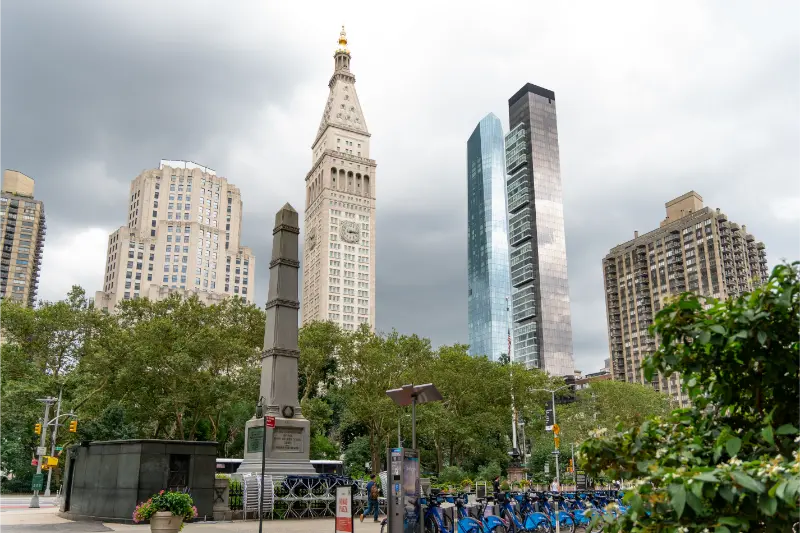
Walk into the park rather than taking a single photo from the nearest corner. Trees, benches and changing foregrounds give the Flatiron a more human scale and make it easier to understand the triangular site.
The northern prow
The famous narrow edge is the image most visitors recognize. Move across the pedestrian plazas and compare how the building appears to widen dramatically as you shift only a few steps.
Broadway and Fifth Avenue sightlines
Walk south and north along both avenues. Each block changes the relationship between the Flatiron, surrounding towers and Madison Square.

Architectural neighbors
The Metropolitan Life tower, New York Life Building and several historic commercial buildings make this area unusually rewarding for travelers interested in architecture.
Visitor access: what to expect
The Flatiron Building should be planned as an exterior stop. It is not a standard public attraction, and the residential conversion does not create a tourist interior. Sidewalks, plazas and park areas around the building can also be affected by work or events, so allow yourself flexibility rather than designing an itinerary around one exact photo position.
Best time to visit
For an architecture-focused visit, weekday mornings are often easiest because sidewalks are calmer and you have more room to look up without stopping in heavy pedestrian traffic. The best photographic light depends on the building orientation, but a clear morning gives crisp detail while late afternoon can bring warmer façades and stronger reflections. If the site is a working institution, house of worship or government building, its operational needs always take priority over sightseeing.
Photography tips
The classic image comes from the north side of the intersection, where the triangular edge points toward you. Early morning generally means fewer people and delivery vehicles. Overcast weather can be excellent because stone details remain visible without deep shadows, while late-day light can warm the façade. Try a vertical composition that includes the street rather than cropping away the urban setting that makes the building special.
How to combine it with nearby sights
Pair the Flatiron Building with Madison Square Park, the Eataly/NoMad area, Union Square and the Empire State Building. If you prefer architecture over shopping, continue east toward Gramercy and historic side streets; if you prefer food and markets, move south toward Union Square.
How much time should you really allow?
The time in the quick-facts table is a realistic sightseeing range rather than a promise. New York landmarks often take longer because the best angle is on another block, security adds a queue, a public room closes temporarily or you simply decide to stay. If this is one of your priority places, avoid placing another timed ticket immediately afterward. A flexible 30-minute buffer usually makes the day more enjoyable.
Is it worth making a special trip?
If you are already in Flatiron District, yes: this is an easy addition and helps you understand the character of the neighborhood. Whether it deserves a dedicated cross-city trip depends on your interests. Architecture and history travelers will often value these places more than visitors focused mainly on shopping or major ticketed attractions. The strongest strategy is to create a themed route where several good stops reinforce one another.
Find a well-located New York hotel for an architecture-focused trip
Frequently asked questions
Can you visit Flatiron Building for free?
Free to see from public streets and Madison Square Park. Always check current official information when interior access, tours or security procedures are important to your visit.
Do I need to book in advance?
Only when the site has a timed tour, reservation system or controlled access. Exterior landmarks and public parks do not need a ticket, but working institutions can impose security or event restrictions. Use the official links below for the latest procedure.
Is it good for children?
It can be, especially when you turn architecture into a visual game: look for unusual shapes, statues, bridge details, old stones or skyline views. For controlled-access sites, check age, height and stroller rules before leaving the hotel.
Is the area accessible by subway?
Yes. Every landmark in this cluster is reachable by New York public transportation, though the final walk can vary considerably. Uptown parks and waterfront sites may involve more slopes or distance than central Manhattan landmarks.
What should I visit nearby?
Use the related Dreaming New York guides below to build a neighborhood route rather than adding unnecessary subway rides. The most efficient New York days group sights geographically.
Related Dreaming New York guides
- Flatiron, NoMad & Union Square Guide
- Empire State Building Guide
- Best Photo Spots in New York
- Shopping in New York City
- New York Architecture & Landmarks Guide
Useful official sources
- Flatiron NoMad – history of the Flatiron Building
- NYC Landmarks Preservation Commission – August 2026 update on the conversion
Final tips
Look up, but also look around. The best New York architecture experience is rarely only about the façade in front of you. Notice the street width, neighboring buildings, public space, transportation and the way people use the site. That wider view turns a famous landmark into a more memorable piece of the city.
A practical architecture-first route
Begin the day with Flatiron Building before the busiest sightseeing period. Spend a few minutes understanding the building or site from more than one angle, then continue on foot to the closest related landmark rather than immediately entering the subway. This style of travel is particularly effective in New York because architectural eras overlap block by block: a nineteenth-century church can face a twentieth-century tower, while a modern transportation hub can sit beside a memorial plaza. The contrasts are part of the story.
If you are carrying a camera, keep the first part of the day simple. One wide-to-standard lens or a phone is often enough. Large bags become inconvenient at security-controlled attractions and make crowded sidewalks harder to navigate. Save indoor museums for the hottest, coldest or wettest part of the day and use better weather for street-level architecture.
What not to expect
Do not assume that every famous New York building has a public roof, observation deck or lobby tour. Many are offices, residences, religious buildings or government facilities. A landmark can still be worth visiting even when the interior is private. In those cases, the surrounding streets, public plazas and nearby institutions provide the visitor experience. Respect security staff, residents and worshippers, and never follow someone through a controlled door simply because it is open.
Details that are easy to miss
Architecture-focused sightseeing becomes more rewarding when you give yourself one extra circuit around the site. Look at materials at street level, entrances, plaques, changes in window rhythm, decorative metal and the transition between the landmark and newer neighbors. These details often explain the building better than a single famous façade. If a historic marker or official interpretive panel is present, read it before relying on social-media captions, which frequently simplify dates or repeat myths.
It is also worth comparing the landmark in daylight and, when practical, after dark. Lighting can change the hierarchy of a façade completely: reflective metal becomes more dramatic, civic interiors glow, and bridges or towers that blend into the daytime skyline become strong visual anchors. You do not need to schedule a second visit solely for this, but if your evening route naturally passes nearby, the contrast is often worth a brief stop.
Weather and seasonal planning
Architecture days are easiest in mild weather because much of the experience happens outdoors. In summer, use early morning for exposed plazas and save air-conditioned interiors for midday. In winter, group buildings tightly so you are not standing outside for long periods. Rain can actually improve photography by deepening stone color and creating reflections, but wind matters at waterfront sites and elevated viewpoints. Check conditions before leaving the hotel and treat weather as part of the route design rather than an afterthought.