

Flatiron, NoMad and Union Square form one of Manhattan’s most enjoyable walking zones because the city changes character every few blocks. You can stand beneath the Flatiron Building, eat beside Madison Square Park, browse around Broadway, cross one of New York’s busiest public squares and reach Greenwich Village without needing the subway once.
This Flatiron, NoMad and Union Square guide treats the three areas as one continuous walk. The route is especially good for travelers who enjoy architecture, food markets, parks, design stores and neighborhoods that feel central without the sensory overload of Times Square.
Where are Flatiron, NoMad and Union Square?
The Flatiron District centers on the intersection of Fifth Avenue and Broadway around 23rd Street. NoMad—short for North of Madison Square Park—extends roughly north from there toward the lower 30s. Union Square sits farther south around 14th to 17th Streets.

The boundaries are informal, and that is part of the appeal. You can explore all three areas naturally on foot and continue south into Greenwich Village or north toward the Empire State Building and Koreatown.
Start at Madison Square Park
Madison Square Park is a compact green space surrounded by some of Manhattan’s most interesting architecture. It provides benches, lawns, public art and a useful place to orient yourself before the walk. Look around rather than immediately searching for the Flatiron Building: the Metropolitan Life Tower and other historic structures frame the park in multiple directions.
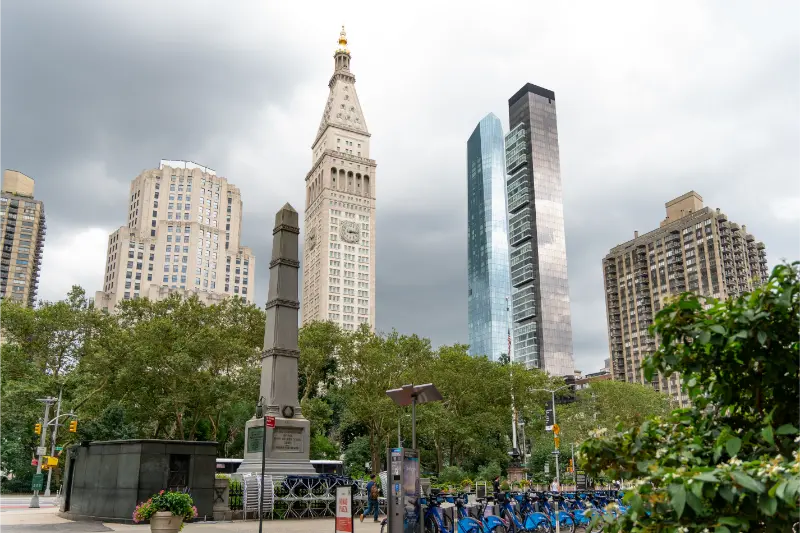
The park is also a reminder that New York’s famous squares are not always geometric plazas. Madison Square grew from an evolving urban landscape and has been part of city life since the 19th century.
The Flatiron Building
The triangular Flatiron Building opened in 1902 and became one of New York’s earliest skyscraper icons. Designed by Daniel Burnham’s firm, it fits the narrow wedge where Fifth Avenue and Broadway cross at 23rd Street. Its shape appears impossibly thin from certain angles, which is why the building photographs so dramatically.
The building has gone through major restoration and redevelopment in recent years, so construction conditions and access around it can change. The exterior remains the reason most travelers come. For the classic view, move around the pedestrian plazas north of 23rd Street rather than trying to photograph it from one fixed position.
Walk Broadway through the pedestrian plazas
Broadway cuts diagonally across Manhattan’s street grid, creating irregular intersections and public spaces. Around Flatiron, pedestrianized sections give you room to stop without blocking the sidewalk. This is one of the best places to understand how street geometry shapes New York.
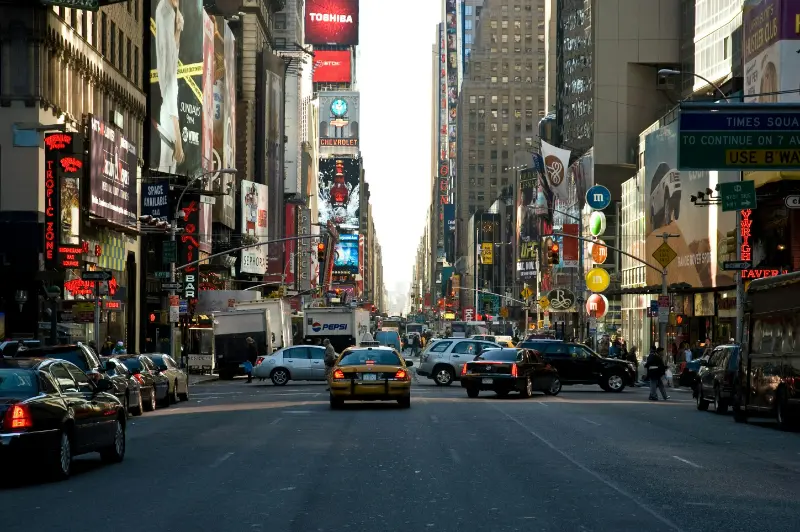
Continue north for a taste of NoMad or turn south toward Union Square. If you have time, doing both creates a satisfying loop.
NoMad: architecture, hotels and food
NoMad has evolved from a business district into a mix of hotels, restaurants, offices and residential buildings. The area feels polished but still retains older commercial architecture. Walking up Broadway toward 28th Street reveals wholesale shops and a surprising concentration of small businesses between newer developments.
Continue a few blocks east and you reach Koreatown around West 32nd Street, one of Manhattan’s best compact dining areas. It works especially well for an evening meal after the Flatiron walk.
Photograph the Empire State Building from the neighborhood
One reason to walk NoMad is the changing view of the Empire State Building. Instead of seeing it only from directly beneath, you get longer perspectives along avenues and side streets. The tower becomes part of the streetscape rather than an isolated attraction.
If you want to go up, compare ticket choices and skyline angles in our best observation decks in New York.
Walk south to Union Square
From Madison Square Park, Fifth Avenue leads directly to Union Square in about 15 minutes. The walk passes shops, old loft buildings and busy cross streets. Broadway runs nearby and offers a slightly more commercial route.
Union Square Greenmarket
The Union Square Greenmarket, operated by GrowNYC, is one of the city’s best-known farmers markets. Farmers and producers from the region sell fruit, vegetables, baked goods, flowers, cheese and other products. Market days and vendor lineups vary seasonally, so check the official GrowNYC page before planning around it.
Even if you are staying in a hotel without a kitchen, the market is worth visiting for snacks, seasonal fruit and the atmosphere. Go earlier for a calmer experience; lunchtime and afternoons can become busy.
Union Square Park
Union Square has long been a place of public gathering, protest, commerce and everyday city life. The park is surrounded by shops and transport, but the central space attracts street performers, chess players, students and workers on lunch breaks.
Do not expect a tranquil park like parts of Central Park. Union Square’s appeal is its energy. Sit for ten minutes and watch how many different versions of New York pass through the same space.
Bookstores and browsing
The area around Union Square is excellent for browsing books, design shops and everyday stores. Strand Book Store at 828 Broadway, just south of the square, is one of New York’s best-known independent bookstores and can easily consume an hour if you enjoy used and new books.
From there, you are only a short walk from the East Village. Pair the afternoon with our East Village and Lower East Side guide.
Where to eat
This part of Manhattan gives you several strategies. Around Madison Square Park and NoMad, there are polished restaurants and hotel dining rooms. Koreatown offers dense Korean dining around 32nd Street. Union Square has casual lunch options, market snacks and easy access to the East Village for dinner.
Instead of choosing a restaurant only because it is beside the Flatiron Building, walk several blocks. Food quality and value usually improve once you leave the most obvious tourist corner.
A practical walking route
- Start at Madison Square Park
- Walk around the Flatiron Building viewpoints
- Continue north on Broadway into NoMad
- Optional detour to Koreatown and Herald Square
- Return south via Fifth Avenue
- Walk to Union Square
- Browse the Greenmarket if operating
- Visit Strand Book Store
- Continue into Greenwich Village or the East Village
Allow three to four hours without a long meal. Add another two hours if you include Koreatown, extensive shopping or a museum stop.
Best time to visit
Morning is excellent for Flatiron photographs because the plazas are less crowded. Late morning and lunchtime make sense on Greenmarket days. Late afternoon creates warm light on the buildings, and evenings are ideal if you continue to Koreatown or the East Village.
How this area fits into an itinerary
Flatiron is a useful connector. It can sit between a morning in Midtown and an evening in Greenwich Village. It also works after the High Line and Chelsea if you take the subway east, although trying to combine every neighborhood into one day can become exhausting.
Our 5-day New York itinerary shows how to group attractions geographically without spending the day underground.
Where to stay
NoMad and Flatiron are excellent hotel locations for travelers who want central geography without being directly in Times Square. You can walk north to the Empire State Building, south to Greenwich Village and west toward Chelsea. Subway access is strong.
The downside is price. Many hotels in the district target business or upscale leisure travelers. Compare rates with Midtown, Chelsea and the Upper West Side before booking.
Practical tips
- Check the Greenmarket calendar if the market is a priority.
- Photograph from pedestrian spaces rather than stepping into bike or traffic lanes.
- Use the neighborhood as a connector between Midtown and downtown.
- Keep some food flexibility: NoMad, Koreatown and the East Village all offer very different options within walking distance.
- Look above storefronts: many of the district’s best architectural details sit several floors up.
Frequently asked questions
Is the Flatiron District worth visiting?
Yes, especially if you like architecture and urban walking. The area is compact and easy to combine with Union Square, NoMad, Chelsea or Greenwich Village.
How long do you need?
Two hours is enough for Madison Square Park, the Flatiron exterior and Union Square. Half a day is better if you add NoMad, shopping and food.
Can you go inside the Flatiron Building?
It is not a standard tourist attraction with public observation access. Visit primarily for the exterior architecture and surrounding streets.
Is Union Square safe at night?
It is a busy central transit and commercial area. As elsewhere in New York, stay aware of belongings and your surroundings, especially on quieter side streets late at night.
A small detail worth noticing
At several intersections, pause before crossing and look back along Broadway. Because it cuts diagonally through the grid, the street creates unusually long sightlines and triangular building corners that you do not get on most Manhattan avenues. Those angles are part of what makes this district feel visually different.
Final thoughts
Flatiron, NoMad and Union Square are not about one blockbuster attraction. Their strength is the sequence: a famous triangular tower, a small park, changing skyline views, a farmers market, bookstores and neighborhoods branching in every direction. Walk them as one connected piece of Manhattan and they become far more interesting than any single pin on a map.
[…] Flatiron, NoMad & Union Square Guide […]