

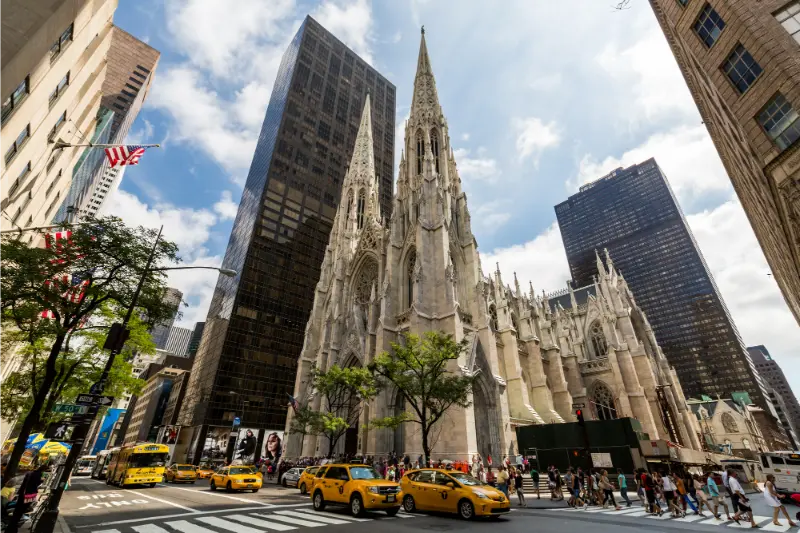
St. Patrick’s Cathedral is one of the rare New York landmarks that can be both a major tourist stop and a functioning place of worship at the same moment. Its Gothic Revival façade rises directly across Fifth Avenue from Rockefeller Center, creating one of Midtown’s most striking contrasts between 19th-century religious architecture and modern towers.

You do not need to be Catholic to appreciate the building. Visitors come for the marble interior, stained glass, chapels, organ, history and the unusual calm that can exist only a few steps from Fifth Avenue traffic. The key is remembering that sightseeing takes place around Masses, confessions, weddings, funerals and private prayer.
This guide focuses on what is useful for planning rather than pretending that every visitor needs the same amount of time. For a wider city plan, start with our New York travel guide and then decide whether this stop matches your interests.
Why visit?
The cathedral gives a first-time New York itinerary something different from observation decks and commercial attractions: a place where architecture, immigration history, religious life and Midtown geography intersect. Because it sits between Rockefeller Center and Fifth Avenue shopping, it is also exceptionally easy to include without adding extra transit.
What to see
The Fifth Avenue façade
Stand across Fifth Avenue first so you can read the twin spires and the cathedral’s scale against surrounding skyscrapers. The contrast is part of the experience; the building was conceived long before Midtown developed into the commercial district visible today.

The nave and high altar
Inside, the long central nave draws the eye toward the sanctuary. Walk slowly and stay aware of roped-off areas or services in progress. The interior is more rewarding when you stop to look at stone, woodwork and light rather than treating it as a five-minute photo stop.
Lady Chapel
The Lady Chapel behind the sanctuary is among the cathedral’s most beautiful spaces. Access can vary depending on liturgical use, so follow signage and staff instructions. Its scale is more intimate than the main nave and rewards visitors who explore beyond the central aisle.
Stained glass and side chapels
Different chapels and windows reveal how the cathedral evolved through donations, memorials and artistic commissions. Some windows are associated with noted makers, and the changing light throughout the day alters the interior dramatically.
The Pietà
The cathedral contains a large Pietà by sculptor William Ordway Partridge. It is easy to miss if you walk only down the center aisle, so look carefully at the side spaces and memorials.
The organ and music
Music is central to cathedral life. If your timing coincides with a Mass or scheduled music, listen respectfully rather than moving around for photographs. The official calendar is the correct place to check services and special events.
Official tours
The cathedral offers an official self-guided audio tour and limited guided experiences. Tour availability and operating hours differ from the broader church opening hours, so reserve through the official tour program if the tour itself matters to you.
Hours and current visitor information
The cathedral’s official FAQ currently lists the church as open from 6:45 AM to 8:45 PM, while the official tour program operates within a narrower sightseeing window. Masses occur throughout the day. Because liturgical events can temporarily restrict tourist movement, check the daily schedule before planning a detailed photo visit.
Admission and tickets
General entry for prayer and ordinary visiting is not structured like a museum admission ticket, while official audio and guided tours are paid experiences. Donations support the cathedral. If you want a tour, use the official program rather than assuming any person offering a service outside is affiliated with the cathedral.
Prices and access rules are among the details most likely to change. If your itinerary depends on a free-admission window, a guided tour or a particular indoor space, check the official website again shortly before visiting.
How long should you allow?
Allow 30–45 minutes for a thoughtful self-guided visit, or roughly an hour for the official audio tour. Add more time if you plan to attend Mass. A rushed five-minute entry shows the scale but misses much of the detail.
New York itineraries often fail because they count attractions but not transitions. Add time to reach the entrance, pass security when applicable, use restrooms, find a café or simply sit down. A well-paced visit is more memorable than squeezing another distant attraction into the final 30 minutes.
Best time to visit
Weekday mornings outside major service times can feel calmer. Holiday weeks are visually special but much busier, particularly around Christmas and Easter. Midday can coincide with Mass, which is meaningful if you want to attend but less suitable for unrestricted sightseeing.
How to get there
St. Patrick’s Cathedral is on Fifth Avenue between 50th and 51st Streets. Rockefeller Center subway stations are nearby, and the cathedral fits naturally into a Midtown walking route with Fifth Avenue, Rockefeller Center, Top of the Rock and Radio City Music Hall.
What to combine nearby
- Rockefeller Center: Directly across Fifth Avenue; combine the cathedral with the plaza, Channel Gardens and an observation-deck visit.
- Fifth Avenue: Walk north or south for major stores, public art, churches and Midtown architecture.
- Museum of Modern Art: A short walk west and north makes MoMA an excellent indoor pairing on rainy days.
- New York Public Library and Bryant Park: Continue south on Fifth Avenue for another major civic landmark and green space.
Keep the second half of the day geographically coherent. New York rewards clustering: two nearby places plus a meal usually make a better day than four famous sights connected by repeated subway rides.
Accessibility, families and comfort
Check the venue’s current accessibility page if elevators, step-free routes, seating or mobility assistance are important. Historic buildings and outdoor landscapes can contain slopes, narrow passages or temporary closures even when the overall attraction is accessible. Families should also look for restroom locations and realistic break points before arriving.
Comfort matters more than visitors expect. Wear shoes suitable for the actual surface—museum floors, cobblestones, garden paths or hills—and carry water when the attraction is mainly outdoors. In hot or very cold weather, shorten outdoor sections and protect the part of the visit you care about most.
Photography and visitor etiquette
- Silence your phone and avoid loud conversations.
- Never cross ropes or enter areas closed for worship.
- Do not photograph people receiving sacraments or praying at close range.
- Remove hats when appropriate and dress in a way suitable for an active church.
- If a service begins, either participate respectfully from an appropriate place or postpone sightseeing.
Common mistakes to avoid
- Treating the cathedral as a photo set while Mass is underway.
- Assuming tour hours and cathedral opening hours are identical.
- Walking only the center aisle and missing side chapels and artwork.
- Visiting at the busiest holiday moment when a quieter architectural visit is your goal.
- Forgetting how easy it is to combine the cathedral with Rockefeller Center instead of making a separate trip.
Frequently asked questions
Is St. Patrick’s Cathedral free to enter?
Visitors can enter the active cathedral without a museum-style general admission ticket, while official audio and guided tours are paid experiences. Donations are welcomed.
What are the opening hours?
The cathedral’s current official FAQ lists opening hours of 6:45 AM–8:45 PM, but sightseeing access can be affected by worship and events.
Can tourists attend Mass?
Yes. Masses are open to worshippers; tourists should participate respectfully and avoid moving around for sightseeing during the service.
How long does the official audio tour take?
The official tour program describes the audio experience as approximately one hour.
Can I take photos?
Photography is generally possible in public visitor areas, but respect worship, staff instructions and any temporary restrictions.
Useful Dreaming New York guides
Check official information before you go
Opening hours, ticket prices, exhibitions, services and temporary closures can change. For the latest information, use the St. Patrick's Cathedral official website. This is especially important if you are traveling on a holiday, attending a special event or building the day around a specific free-admission period.
Is it worth adding to your New York trip?
Yes, when it adds a type of experience your itinerary does not already have. New York is too large to see by collecting every famous name. Choose attractions that create contrast—architecture after a shopping morning, a garden after several indoor museums, or a quiet historic site after Times Square. That rhythm is what makes a long New York trip feel rich rather than exhausting.
How to fit the visit into a realistic day
Start with one fixed anchor—this attraction—then add only places that are genuinely close. Leave room for a meal and at least one unscheduled stop. New York days become tiring less from walking itself than from repeated queues, security checks and cross-town transfers. A compact plan usually gives you more useful sightseeing time than a larger list.
If weather matters to the experience, keep a backup day in your itinerary. Gardens, cemeteries and outdoor campuses can be dramatically better in comfortable weather, while museums and churches can protect a rainy afternoon. Swapping days is easier when you have not prepaid every hour of the trip.
What to bring
A small bag, comfortable shoes and a charged phone are enough for most visits. Add water and sun protection for outdoor sites, and a light layer for air-conditioned interiors. Avoid carrying luggage to museums or historic buildings unless their official policy clearly allows it; hotel storage is usually easier than discovering a restriction at the entrance.
For photography, a phone or small camera is sufficient unless the venue specifically permits larger equipment. Tripods and professional shoots often have separate rules. The best images usually come from patience and good light rather than from carrying more gear.