

Prospect Park is Brooklyn’s great landscaped park and one of the best places in New York to slow down after several days of museums, observation decks and dense city streets. Designed by Frederick Law Olmsted and Calvert Vaux after their work on Central Park, it has its own character: a vast meadow, wooded ravine, lake, boathouse, zoo, historic carousel and a strong neighborhood atmosphere.
For visitors, the biggest advantage is that Prospect Park rarely needs to be treated as a single attraction. It can be a morning walk before Brooklyn Museum, a picnic after the Botanic Garden, a family stop, a running route or the green center of a full Park Slope day. This guide focuses on what is actually worth seeing and how to choose a route without trying to cover every path.
Where is Prospect Park?
The park sits between Park Slope, Prospect Heights, Crown Heights, Prospect Lefferts Gardens and Windsor Terrace. Grand Army Plaza is the most famous northern entrance, while Prospect Park Southwest and Ocean Avenue provide useful access from other neighborhoods.
Subway choices include the 2/3 near Grand Army Plaza and Eastern Parkway, the B/Q/S near the southeastern side, and the F/G toward the western edge. Your best station depends on the route you want rather than simply the closest stop on a map.
Start at Grand Army Plaza
For a first visit, Grand Army Plaza is the most dramatic entrance. The Soldiers’ and Sailors’ Memorial Arch gives the park an immediate sense of scale, and the Brooklyn Public Library sits nearby. From here you can enter toward the Long Meadow or walk east toward Brooklyn Museum and the Botanic Garden.
Weekend farmers markets and local events can make the plaza lively, but schedules change. If your goal is a quiet early walk, arrive before the busiest part of the morning and continue into the park rather than lingering at the traffic circle.
The Long Meadow
The Long Meadow is one of the park’s signature landscapes: a broad ribbon of grass that feels surprisingly open for Brooklyn. It is ideal for a picnic, a pause with children or simply seeing how local residents use the park rather than moving from landmark to landmark.
In warm weather the meadow can be active with groups, games and sunbathers. Walk along its edge if you want shade, or cut into the woodland paths when you are ready for a quieter environment.
The Ravine and woodland paths
Prospect Park’s Ravine is one of its most atmospheric areas. Trees, streams, bridges and uneven paths create a sense of separation from the surrounding city. It is not wilderness, but it is the closest thing to a forest walk many visitors encounter during a central Brooklyn day.
Wear shoes with decent grip after rain, and do not rely only on phone navigation. Paths can curve and split in ways that make the park feel larger than it looks. A park map is useful if you have a timed museum or garden reservation afterward.
The Boathouse and Lullwater
The historic Boathouse is one of the park’s most photogenic buildings, especially from across the Lullwater. The surrounding bridges and water views are worth seeking out even if there is no event inside. This is a good midpoint between wooded paths and the lake.
Birdlife can be surprisingly rich around the water. Prospect Park is an important stop for migratory birds, and spring and fall are especially rewarding if you bring binoculars or simply slow down enough to notice what is happening away from the main lawns.
Prospect Park Lake
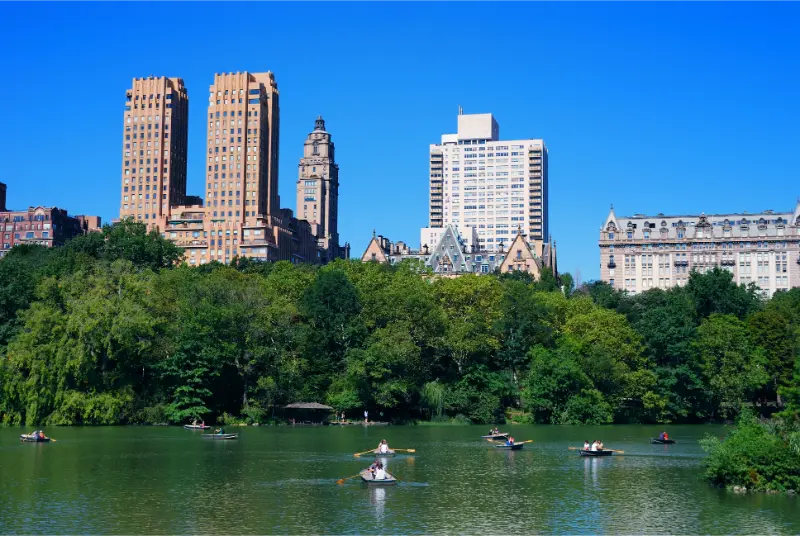
The lake occupies the southern part of the park and gives the landscape a different scale. Walking around it takes longer than many first-time visitors expect, so include it only if you have a half-day rather than a quick hour.
For a shorter visit, approach the lake from Lakeside, enjoy the waterfront and then exit toward Parkside Avenue or return through the interior. There is no need to complete a full loop simply to say you did it.
LeFrak Center at Lakeside
The LeFrak Center changes with the seasons. In warmer months it can host roller skating and other activities; in winter it becomes a major ice-skating destination. Prices and public-session schedules change, so check the current Lakeside calendar rather than assuming skating is always available.
Even if you do not skate, Lakeside is useful for restrooms, food and a break during a long park walk. Families often find this part of the park easier to manage than the more wooded interior.
Carousel and family attractions
Prospect Park’s historic 1912 Carousel is a classic family stop, with carved horses and other animals. The Prospect Park Alliance currently operates rides seasonally on selected days, so check the day’s schedule if a child is counting on it.
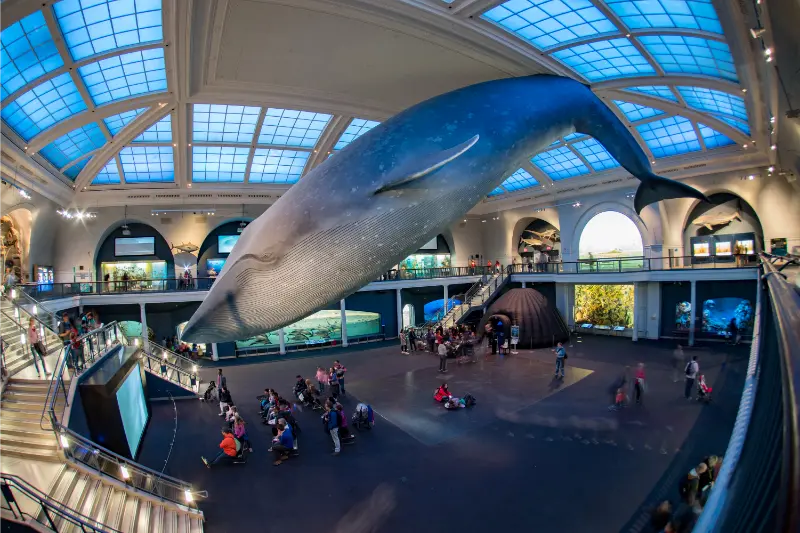
The park also includes Prospect Park Zoo. If you are planning a family day, combine one structured attraction with free outdoor time rather than stacking several ticketed stops. Our New York with kids guide explains why this pacing works especially well in a city with so much walking.
Prospect Park + Brooklyn Museum
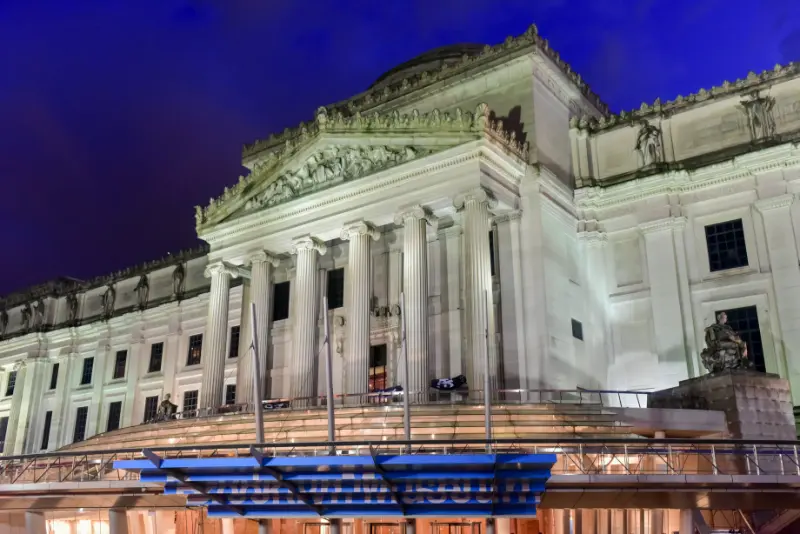
The museum is immediately northeast of the park. Start with two or three hours at the new Brooklyn Museum guide, then enter the park through Grand Army Plaza for a less structured afternoon. This is an excellent rainy-morning/sunny-afternoon plan.
Prospect Park + Brooklyn Botanic Garden
The Brooklyn Botanic Garden is also next door. In spring, the garden may be the primary attraction while Prospect Park provides open space afterward. In autumn, the park’s broader tree canopy can be just as rewarding as the formal garden.
A 90-minute first-time route
Enter at Grand Army Plaza, walk along the Long Meadow, cut through woodland toward the Boathouse, then continue toward the Lullwater. From there, either exit toward the Botanic Garden side or turn south toward Lakeside if you have more time.
This route gives you architecture, meadow, trees and water without attempting a complete circuit. Save the lake loop and southern sections for a longer visit.
Best seasons
Spring brings blossoms, migrating birds and fresh green woodland. Summer is best for picnics and long evenings but can be hot and busy. Fall is arguably the most beautiful season for color, while winter can be stark and quiet, especially after snow.
For broader seasonal planning, compare our New York in spring and New York in fall guides.
Safety and practical habits
Prospect Park is heavily used by local residents, runners, cyclists and families. As in any large urban park, stick to well-used routes if you are unfamiliar with the area, particularly after dark. Cyclists can move quickly on park roads, so look before crossing and avoid drifting into marked lanes while taking photos.
Common mistakes
- Trying to walk every section on the same day as two museums.
- Ignoring the woodland interior and seeing only the Long Meadow.
- Assuming skating, carousel rides or boating operate every day.
- Underestimating distances around the lake.
- Using the park only as a shortcut instead of giving it at least an hour.
Is Prospect Park worth visiting?
Yes, especially if your trip includes Brooklyn Museum, the Botanic Garden or Park Slope. It is not a substitute for Central Park, and it does not need to be. Prospect Park offers a different experience: more neighborhood-oriented, less centered on famous monuments and often easier to enjoy without a checklist.
The best visit is the one that leaves some of the park unseen. Choose a few landscapes, sit down for a while and let the day slow. In a New York itinerary, that can be more valuable than adding another attraction.
A simple planning rule
Before you lock this stop into the day, decide what role Prospect Park Guide plays in your itinerary. If it is a priority, give it the best available time and protect that block from unnecessary cross-town travel. If it is optional, keep it flexible and move it according to weather, energy and nearby reservations.
New York days work best when each half-day stays geographically coherent. Group attractions that can be reached on foot, leave realistic meal and security time between timed entries, and avoid treating the subway as instantaneous. A route that looks efficient on a map can still become exhausting when every stop requires another line, staircase or crowded transfer.
Finally, check the official site the evening before visiting. Hours, entrances, temporary closures, exhibitions and weather-related access can change. That two-minute check is more useful than relying on an old screenshot or a travel post that may have been accurate when it was published.
How to fit it into a New York itinerary
The easiest way to make Prospect Park Guide work is to pair it with places in the same part of the city. Avoid crossing Manhattan or changing boroughs only to fill a spare hour. New York rewards compact days: one major anchor, one nearby neighborhood and one flexible stop usually feel better than four reservations scattered across the map.
If you are traveling for the first time, protect the morning for the place you care about most and keep the afternoon looser. Security lines, subway delays, weather and meal stops can all move a schedule by twenty or thirty minutes. Building that margin into the day makes it much easier to enjoy the visit rather than watching the clock.
For repeat visitors, use this stop as a reason to explore the surrounding streets rather than treating it as an isolated destination. A museum, park or landmark becomes more memorable when it is connected to a neighborhood meal, a local walk or a waterfront view. That is also the simplest way to discover a version of New York that feels less like a checklist.
Before leaving the hotel, check service changes on the subway, confirm the attraction or venue is operating normally, and save the address offline. Mobile coverage is generally good, but underground stations and crowded areas are exactly where having the basic route already saved can reduce unnecessary stress.