

Landing at John F. Kennedy International Airport can feel like the final hurdle before New York begins. JFK sits in Queens, well away from Midtown, and the best transfer depends less on a single ‘fastest’ option than on where you are staying, how much luggage you have, how many people are traveling together and what time you arrive.
For most visitors, the useful choice is between AirTrain plus the Long Island Rail Road, AirTrain plus subway, a yellow taxi, or a pre-booked car. AirTrain is the key public-transport link from every passenger terminal. The airport currently charges $8.75 when you enter or exit at Jamaica or Howard Beach, while travel between airport terminals remains separate from that paid exit point.
For a broader orientation before choosing a transfer, see our guide to getting around New York. The goal is not to pick the method that sounds most local, but the one that fits your destination, luggage and arrival time.
The quick answer
For Midtown, AirTrain to Jamaica followed by the Long Island Rail Road is usually the easiest public-transport choice when you value speed and a simpler rail ride. AirTrain to Jamaica plus the E subway, or AirTrain to Howard Beach plus the A, is cheaper and can be excellent when your hotel is close to those lines. A yellow taxi becomes more attractive for two to four travelers with luggage, especially when the destination is not convenient by rail.
Your main options
AirTrain + Long Island Rail Road via Jamaica
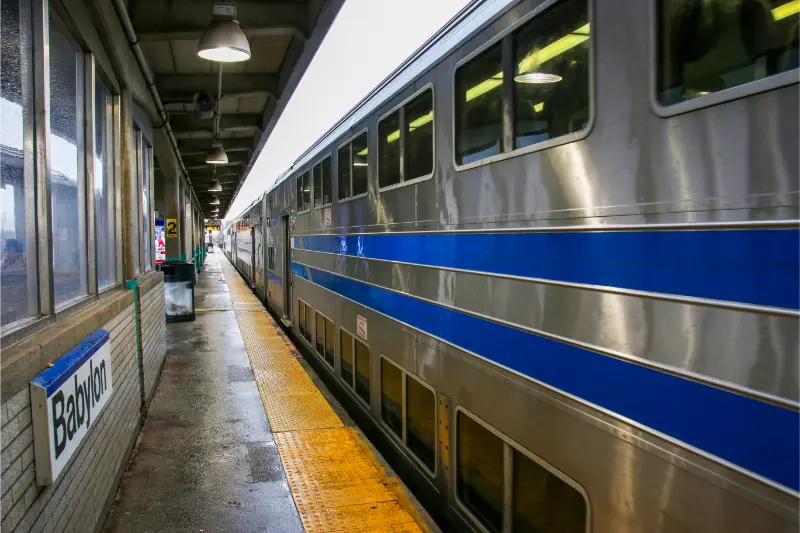
Take the AirTrain from your terminal to Jamaica Station, then follow signs for the Long Island Rail Road. LIRR trains reach Penn Station and Grand Central Madison, giving Midtown visitors two useful arrival points. This route reduces the number of subway stairs and is often the most comfortable public option after a long flight. Buy the LIRR portion through the TrainTime app or station machines and check whether your train is peak or off-peak before boarding.
AirTrain + E subway via Jamaica
At Jamaica, you can transfer to the E train instead of LIRR. This is usually cheaper, and the E is useful for Midtown West, Times Square-area connections and parts of Queens. The trade-off is a longer ride with ordinary subway conditions: more stops, less luggage space and a greater chance of standing during busy periods. It is a strong budget option if your hotel is close to an E station.
AirTrain + A subway via Howard Beach
The Howard Beach branch connects with the A train. This route can make sense for Lower Manhattan, parts of Brooklyn or hotels positioned conveniently along the A. Do not choose it simply because the A is an express line; compare the exact hotel address against the Jamaica routes. The correct airport transfer is the one that minimizes awkward transfers after you leave the train.
Yellow taxi to Manhattan
NYC yellow taxis use a regulated flat fare of $70 between JFK and Manhattan, before applicable surcharges, tolls and tip. The final amount is therefore higher than $70. Use only the official taxi dispatch line outside the terminal and ignore anyone approaching you inside arrivals offering a cab. For families or small groups, the per-person difference versus rail can shrink enough to justify door-to-door convenience.

Ride-hail or pre-booked car
App-based and pre-booked vehicles offer door-to-door service, but prices vary with demand, traffic and vehicle type. They are particularly useful when you need a child seat arranged in advance, have oversized luggage, arrive very late, or are staying somewhere awkward for public transportation. Confirm the official pickup zone in your terminal before requesting a car.
Shared shuttle or hotel transfer
Shared shuttles can look inexpensive when booked individually, but multiple hotel stops may lengthen the trip. They work best for travelers who prioritize a fixed booking over speed. Always compare the total price for your party against a taxi or car service rather than comparing only the single-person advertised rate.
Which option is best for you?
| Traveler or destination | Best option to compare first |
|---|---|
| Solo traveler on a budget | AirTrain plus subway usually gives the lowest practical cost. |
| Solo traveler prioritizing speed | AirTrain plus LIRR is often worth the extra rail fare. |
| Couple with two suitcases | Compare LIRR against taxi or ride-hail; the convenience gap may matter more than a small saving. |
| Family or group of three to four | A regulated taxi can become competitive on a per-person basis and avoids station stairs. |
| Hotel in Lower Manhattan | Compare A train from Howard Beach with LIRR/subway connections through Jamaica rather than assuming Midtown routes are best. |
| Late-night arrival | Check live rail service first; if planned work or long waits appear, a licensed taxi or pre-booked car may be the calmer choice. |
A simple step-by-step plan
- Before landing, save the full hotel address and nearest subway station offline.
- Follow airport signs to AirTrain or the official taxi/ride-hail pickup area; do not follow solicitors.
- If using AirTrain, check whether Jamaica or Howard Beach gives the cleaner connection to your destination.
- Use the same contactless payment method consistently where OMNY applies, and keep your LIRR ticket separate if using commuter rail.
- Once in Manhattan, avoid adding an unnecessary subway transfer if walking a few blocks is easier with luggage.
How to estimate travel time realistically
Do not plan an airport or subway transfer using only the time shown between two stations. Add walking inside the terminal or station, waiting for the next train or bus, finding elevators, buying or activating any rail ticket, and the final walk from the arrival station to your hotel. New York transfers become stressful when a theoretical journey time is treated as a guaranteed door-to-door promise.
For airport arrivals, immigration and baggage claim create the largest uncertainty. For ordinary subway trips, weekend construction is more important. If you have a Broadway curtain, dinner reservation or timed observation-deck ticket, build a buffer rather than planning to arrive at the exact minute shown by a route planner.
Luggage, families and accessibility
A route that is easy with a backpack can feel completely different with two suitcases, a stroller or limited mobility. Check elevator availability at the stations you intend to use, and remember that not every New York subway station is step-free. Families should also consider whether changing trains on a crowded platform is worth a relatively small saving compared with a direct vehicle.
If you need a child safety seat or an accessible vehicle, arrange that requirement explicitly with a legal car-service provider rather than assuming the vehicle waiting at the airport will have the equipment you need. Public transportation can be accessible, but the practical route may require a different station than the closest one on a map.
Practical details that make the trip easier
JFK is large, so terminal-to-AirTrain walking time and elevator waits are part of the transfer. Give yourself more buffer when traveling with children, mobility devices or several bags.
If your phone battery is low after a long flight, connect to airport Wi-Fi and screenshot the route before leaving the terminal. A small power bank is one of the most useful New York travel accessories.
Weekend and overnight service changes can alter subway routes. Check MTA planned work on the day of travel rather than relying on a route saved weeks earlier.
Safety and avoiding transport scams
Use official taxi queues, signed airport transportation areas, MTA facilities and recognized apps. Ignore unsolicited drivers who approach you inside baggage claim or near terminal exits. Keep your phone and wallet secure while reading directions, and step away from the flow of commuters before stopping to check a map.
On the subway, normal big-city awareness is enough for most visitors: keep bags closed, do not leave phones loosely in an open pocket near doors, and move to another car or a busier area if a situation makes you uncomfortable. Our New York safety guide goes into more detail.
Common mistakes to avoid
- Taking the first private-car offer from someone inside the terminal.
- Choosing the subway without checking whether the hotel requires another difficult transfer.
- Assuming the $70 JFK taxi flat fare is the final total after all surcharges and tip.
- Using different contactless cards for connected OMNY trips and losing transfer or fare-cap benefits.
- Planning a timed attraction too soon after the scheduled landing time.
Frequently asked questions
Is AirTrain JFK free?
Travel between airport terminals does not require the paid Jamaica/Howard Beach exit fare, but the current single-ride fare charged when entering or exiting at Jamaica or Howard Beach is $8.75.
Can I use OMNY for AirTrain JFK?
Yes. OMNY states that contactless bank cards, smart devices and OMNY cards can be used at Jamaica and Howard Beach to pay the AirTrain fare.
Is a taxi cheaper for a family?
It can be. Public transport is priced per person, while one taxi fare covers the vehicle. Compare the full regulated taxi cost, including surcharges, tolls and tip, against the combined rail fares for your group.

Which route is best for Times Square?
Jamaica is normally the most useful AirTrain exit. From there, compare LIRR to Penn Station/Grand Central with the E subway depending on your exact hotel.
How much time should I allow after landing?
Immigration, baggage claim, terminal walking and traffic are unpredictable. Do not treat scheduled landing time as the moment you will leave the airport.
Useful Dreaming New York guides
- New York airports guide
- getting around New York
- OMNY guide
- New York on a budget
- where to stay in New York
Check the official information before you travel
Fares, construction, pickup areas and service patterns can change. Before a time-sensitive journey, check the JFK Airport AirTrain information and live transit alerts. A travel guide should help you understand the choices; the official operator should always be the final source for same-day operations.
Final advice
The best New York transportation choice is usually the one with the fewest points of friction, not the one that saves the last few dollars or minutes on paper. A direct route that leaves you calm, oriented and close to your hotel can be better value than a complicated chain of transfers after an overnight flight. Learn the system, keep a backup option and let live conditions decide the final route.